Adamson BBQ and the Evidence Test Governments Should Never Fear
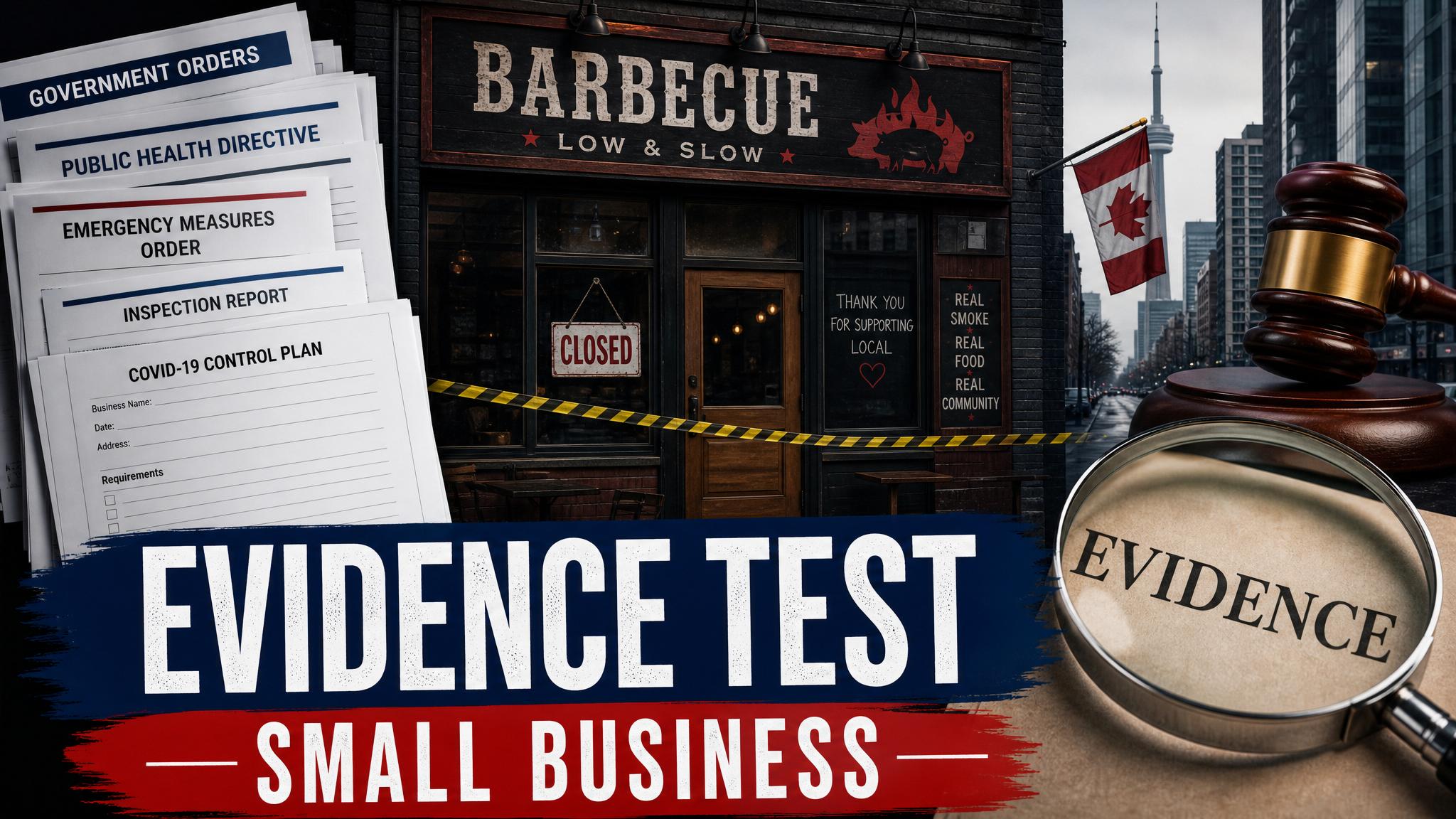
The Adamson BBQ story is not only a lockdown story. It is an evidence story. When government uses emergency power to close a business, suppress a protest, change locks, arrest an owner and send a life-altering bill, Canadians are entitled to ask one basic question: show us the proof.
The Facebook video circulating this week features Odessa Orlewicz discussing Adam Skelly’s long-running fight over the 2020 closure of Adamson Barbecue. The headline claim is dramatic: Toronto Public Health was embarrassed because officials could not produce the scientific evidence needed to justify what happened. That framing is partisan and punchy. But underneath the rhetoric is a serious democratic issue conservatives should not ignore.
In November 2020, Skelly reopened his Etobicoke restaurant for in-person dining in protest of COVID restrictions. His side says the protest was deliberate: he wanted public attention, legal scrutiny and a debate about whether broad restaurant closures were proportionate, scientific and fair to independent small businesses.
The response was overwhelming. According to Skelly’s 2026 factum, the City’s then-medical officer of health, Dr. Eileen de Villa, issued orders; the premises were taken out of Skelly’s control; police surrounded the restaurant; Skelly was arrested; and the legal consequences dragged on for years. Rebel News reported in February that Skelly had been fined, criminally charged, held in a cell for roughly 30 hours, put out of business, and invoiced by the city for about $187,000 in policing costs.
Emergency does not erase accountability. It raises the standard for accountability.
The uncomfortable part: what was actually tested?
The strongest part of the story is not that every lockdown critic was right about every scientific claim. The strongest part is narrower and harder to dismiss: when a government restricts Charter freedoms, it must be ready to prove the restriction was justified.
Skelly’s legal team argued that the respondents carried the burden under section 1 of the Charter to prove serious infringements were reasonable and demonstrably justified. Their factum says the record disclosed no evidence that closing restaurants or prohibiting peaceful assembly would meaningfully reduce transmission. It further alleges that Dr. de Villa performed no site-specific investigation of Adamson BBQ, identified no outbreak or transmission event at the premises, relied on generalized data, and failed to consider less intrusive alternatives.
Those are Skelly’s allegations and legal arguments — not a neutral court finding in this article. But they matter because the supporting transcript raises real questions about preparation and evidentiary confidence. In cross-examination, de Villa acknowledged she had not reviewed all of Skelly’s expert evidence and could not name one expert from his application record off the top of her head. Asked whether she could answer questions about those experts’ evidence, she replied that it was fair to say she was not in a good position to comment specifically.
That is not a small point. If citizens are expected to obey sweeping restrictions because experts and officials say they are necessary, then those same officials should be able to face evidence, explain the basis of their orders, and show why less damaging alternatives were rejected.
The government side deserves to be stated fairly
A good story does not hide the other side. City lawyers argued, according to Rebel News’ court report, that Dr. de Villa should not be judged by a “standard of perfection,” that critics were looking backward with the benefit of hindsight, and that public health officials deserved deference during an emergency. The City also relied on the broader legal principle that courts have often given governments room to act when the science is uncertain and public health risks are evolving.
That argument cannot simply be waved away. In 2020, COVID was new, hospital capacity was a real concern, and governments were making decisions under pressure. Some restrictions may have been legal, justified, or at least understandable at the time.
But “we were under pressure” cannot become a permanent shield. Deference is not a blank cheque. If the state destroys a small business and overrides peaceful assembly, it should be able to show its work.
Why conservatives should own this issue
The Adamson BBQ fight lands because it puts flesh on an abstract principle. “Civil liberties” can sound academic until it becomes one restaurant, one family business, one owner, one set of locked doors and one question that never goes away: why this much force?
A positive Conservative response should not be reckless. It should not pretend there are no emergencies. It should say something better: free countries need emergency rules that are transparent, time-limited, reviewable, evidence-based and respectful of small business.
- Before closing businesses, government should publish the evidence and alternatives considered.
- Before suppressing peaceful assembly, government should prove why accommodation is impossible.
- Before using police and property-control measures, government should show clear statutory authority.
- After the emergency, independent review should test what worked, what failed and what should never happen again.
- Officials should answer questions without hiding behind slogans, credentials or hindsight arguments.
This is also an affordability issue. Small businesses are not abstractions. They are jobs, leases, suppliers, savings, debt, families and neighbourhoods. When big-box stores survive and independent operators are crushed, trust breaks. People begin to believe the rules are not only harsh, but uneven.
The lesson now
The lesson of Adamson BBQ is not that every person should defy every rule. That is not responsible government. The lesson is that government power must remain answerable to evidence, law and proportionality — especially when fear is high.
Canada will face future emergencies: pandemics, cyberattacks, natural disasters, public-safety crises. The question is whether we learned anything. Conservatives should be the voice saying yes: protect the vulnerable, tell the truth, respect rights, publish the evidence, and never treat small business owners as disposable.
Bottom line: if a government order is strong enough to shut a business, seize control of premises and bring police to the door, it should be strong enough to survive a clear evidence test in public.